
How Much Do Architects Cost for Residential and Commercial Projects in the USA?

Introduction
When planning a construction project—whether it’s a dream home, a remodel, a retail store, or a large commercial building—one of the very first questions people ask is:
“How much does an architect cost in the USA?”
It’s an essential question because architecture isn’t just about drawing plans. It’s about shaping the spaces where people live, work, and thrive. Whether you’re a homeowner adding an extra room, a builder managing multiple projects, a realtor guiding clients on property value improvements, or a business owner planning a new facility, the cost of hiring an architect is a key part of the overall budget.
Architectural costs in the USA vary widely, and for good reason. A small kitchen renovation in Texas will not carry the same design costs as a luxury home in California or a multi-story office building in New York. Factors such as project size, complexity, location, materials, sustainability goals, and permitting requirements all play a role.
This comprehensive guide will explain exactly what goes into architect costs in the USA, covering both residential and commercial projects. You’ll learn about the different pricing models, the services included, regional variations, hidden fees to watch for, and most importantly, how to budget effectively.
At Unified Studio Architect, we’ve worked on more than 350 projects nationwide across residential, commercial, and institutional sectors. With extensive experience in state-by-state building codes, permit processes, and construction practices, we provide transparent, cost-effective solutions tailored to our clients’ needs.
By the end of this guide, you’ll have a clear understanding of:
- What architect costs typically cover.
- The differences in residential and commercial architect fees.
- How geographic location impacts pricing.
- What factors can increase or reduce fees.
- How to budget wisely and get maximum value from architectural services.
What Do Architect Costs Cover?
When you hire an architect in the USA, you aren’t just paying for drawings. You’re investing in a structured process that turns an idea into a buildable, code-compliant, and cost-effective reality. Here’s what architect costs typically cover:
1. Design Development
Architects translate your vision into tangible concepts. This involves initial sketches, conceptual layouts, and refinement of the overall look and feel of the project. For residential clients, this may mean planning room layouts or façade design. For commercial clients, it includes space planning, circulation, and branding alignment.
2. Drafting and Construction Drawings
Permit-ready drawings are one of the core deliverables. These detailed documents include floor plans, elevations, sections, and technical specifications needed for approval and construction.
3. Permit Coordination
Every U.S. state and city has its own codes, zoning laws, and permit procedures. Architects prepare documents for submission and respond to city review comments, saving clients time and costly mistakes.
4. Site Visits and Construction Administration
During construction, architects may visit the site to ensure work is consistent with the design. They answer contractor questions, approve materials, and help resolve issues on-site.
5. Project Management Support
For larger projects, architects coordinate with engineers (structural, MEP), surveyors, and consultants, ensuring all disciplines align with the design intent.
Why Hiring an Architect Adds Value
Some clients consider skipping an architect to save money. However, the risks often outweigh the savings. Without proper drawings, you risk:
- Delays in permitting.
- Errors in construction that require expensive changes.
- Missed opportunities for energy efficiency.
- Reduced resale or rental value due to poor design.
Hiring an architect is not just an expense—it’s an investment in accuracy, compliance, and long-term value.
Residential Architect Costs in the USA

Residential projects—homes, remodels, additions, and accessory dwelling units (ADUs)—make up a large portion of architectural work in the U.S. Understanding how costs are calculated will help homeowners and builders budget more effectively.
Pricing Models for Residential Architects
- Percentage of Construction Cost
- Common for custom homes and large remodels.
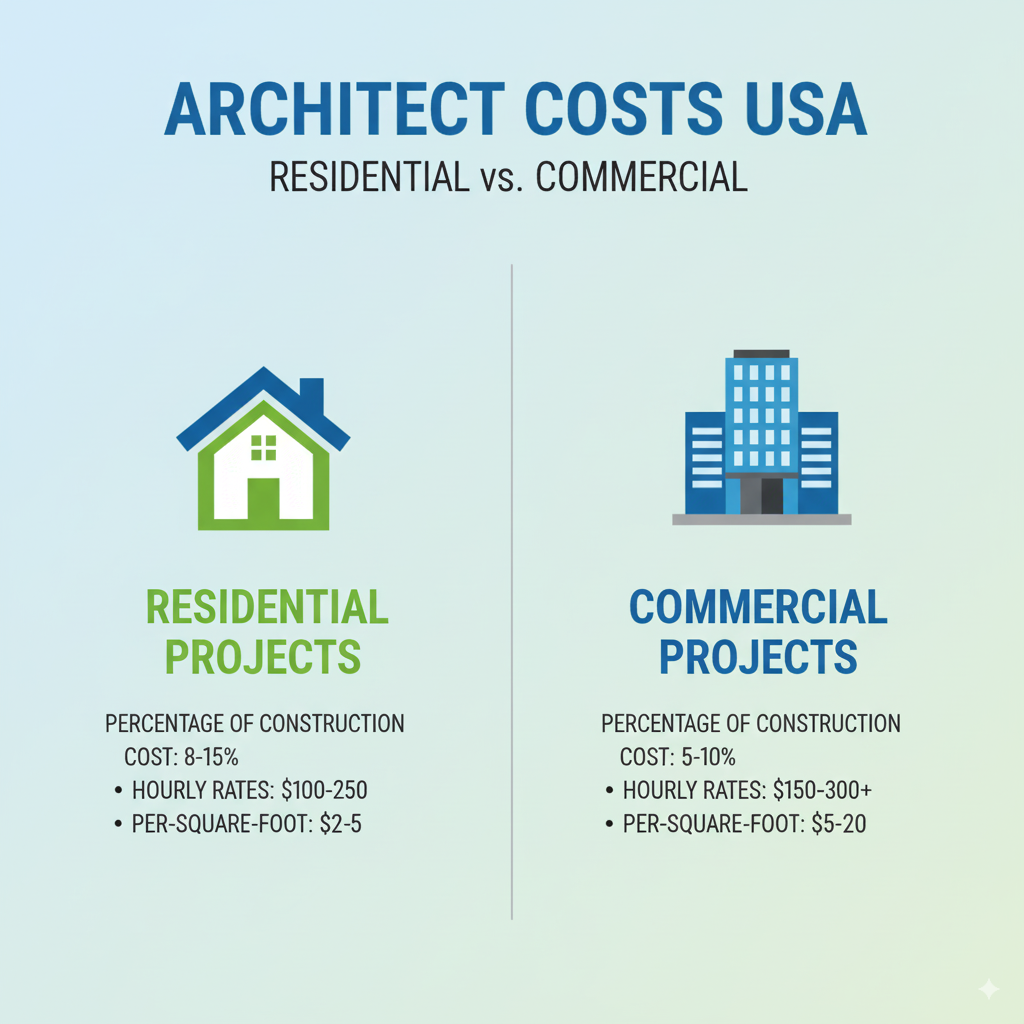
- Typically ranges from 5% to 15% of total construction costs.
- Example: For a $500,000 home, architect fees could be $25,000–$75,000.
- Hourly Rates
- Used for smaller projects or consultation services.
- Average U.S. rates: $100–$250 per hour.
- Example: Reviewing plans for a small kitchen remodel might cost $2,000–$3,000 in total.
- Flat Fees
- Popular for standardized services like drafting or permit sets.
- Example: A permit drawing set for a home addition may cost $5,000–$10,000.
- Per-Square-Foot Pricing
- Common for residential projects where scope is clear.
- Ranges between $2 to $15 per square foot, depending on complexity.
- Example: A 2,000 sq. ft. home might cost $10,000–$30,000 in architect fees.
Typical Residential Cost Scenarios
- Small Remodel (Bathroom/Kitchen): $2,500–$10,000 in fees.
- Medium Remodel or Addition: $8,000–$20,000.
- Custom Home (2,500 sq. ft.): $30,000–$80,000.
- Luxury Home (5,000+ sq. ft.): $100,000–$300,000+.
Geographic Differences in Residential Architect Costs
- Texas: More affordable; $2–$8 per sq. ft. or 5–10% of construction.
- California: Higher costs; $8–$15 per sq. ft. or 10–15% of construction.
- New York: Premium pricing; 12–18% of construction for custom homes.
- Florida & Georgia: Mid-range; competitive rates due to high demand for residential builds.
Commercial Architect Costs in the USA

Commercial projects—such as office spaces, retail stores, restaurants, and mixed-use developments—typically involve more complexity, larger teams, and stricter compliance requirements than residential projects.
Pricing Models for Commercial Architects
- Percentage of Construction Cost
- Common for large-scale projects.
- Typically 6% to 12% of construction costs.
- Fixed Fee or Lump Sum
- Based on project scope and deliverables.
- Example: A small retail fit-out may have a fixed fee of $15,000–$40,000.
- Hybrid Models
- A mix of hourly rates for early design and percentage for construction phases.
Typical Commercial Cost Ranges
- Small Retail Fit-Out (1,500 sq. ft.): $15,000–$30,000.
- Restaurant Build-Out: $25,000–$60,000.
- Office Renovation (10,000 sq. ft.): $80,000–$200,000.
- Institutional/Healthcare Facility: $150,000–$500,000+.
- Mixed-Use Development: Often 7–10% of construction costs.
Factors That Raise or Lower Costs
- Complexity of Design: High-end restaurants or medical spaces require more customization.
- Permit Requirements: Cities like New York or San Francisco require more review cycles.
- Sustainability Goals: LEED-certified or net-zero projects increase design hours.
- Technology Use: BIM and 3D modeling streamline workflows but may carry higher upfront costs.
Factors That Influence Architect Fees
Regardless of whether the project is residential or commercial, several common factors influence costs:
- Project Size and Complexity – Larger and more complex buildings require more design hours.
- Location – Urban markets like New York or San Francisco cost more than suburban or rural areas.
- Technology – Advanced visualization tools, BIM, and AI add value but impact costs.
- Permit and Code Requirements – More stringent codes equal more detailed drawings.
- Sustainability Goals – Green building standards require additional expertise and coordination.
Hidden or Additional Costs Clients Should Know
Beyond standard fees, clients should budget for potential additional costs:
- Revisions or Redrafting if scope changes mid-project.
- Permit Resubmittals if city comments require revisions.
- Engineering Consultants (structural, mechanical, electrical).
- Site Surveys and Inspections prior to design.
- Interior Design Services if included.
How to Budget for an Architect in the USA
For Homeowners
- Start with a clear scope (avoid frequent changes).
- Ask for detailed proposals (hourly vs flat vs percentage).
- Set aside 10–15% contingency for design adjustments.
For Commercial Developers and Business Owners
- Account for consultant coordination (engineers, sustainability).
- Factor in permitting timelines.
- Request phased invoicing aligned with milestones.
At Unified Studio Architect, we help clients stay within budget by:
- Providing clear proposals.
- Managing revisions efficiently.
- Offering nationwide knowledge of codes and permits.
Comparing Architect Costs to Project ROI
While fees may seem high at first, the long-term returns justify the investment:
- Avoiding Costly Errors: Accurate drawings prevent on-site mistakes.
- Increased Property Value: Well-designed homes and offices command higher resale or rental value.
- Energy Savings: Sustainable designs reduce utility costs for decades.
Geographic Coverage and Local Insights
Architectural costs vary not only by project type but also by geography. Unified Studio Architect serves clients across the USA, including:
- Texas – Affordable rates, fast-growing cities like Austin, Dallas, Houston.
- Florida – Residential demand driven by relocations and coastal builds.
- New York – Premium market, higher permitting complexity.
- California – Sustainability-driven designs, high labor costs.
- Illinois – Balanced costs in Chicago and surrounding suburbs.
- Georgia – Competitive commercial and residential markets.
- Maryland – Complex permitting in Montgomery and Baltimore Counties.
For clients searching for “architect near me”, we provide localized support tailored to each state and city.
Frequently Asked Questions
Q1: How much does an architect cost per square foot in the USA?
Architect fees typically range from $2–$15 per square foot, depending on project type, complexity, and location.
Q2: Do architects charge differently for residential vs commercial projects?
Yes. Residential fees often range from 5–15% of construction, while commercial fees range 6–12%.
Q3: Can I hire an architect just for permit drawings?
Yes. Many firms, including Unified Studio Architect, offer standalone permit drawing services for a flat fee.
Q4: How much do architects charge per hour in the USA?
Hourly rates generally range from $100–$250 per hour, depending on expertise and region.
Q5: Is it worth paying for an architect?
Absolutely. Architects help avoid costly mistakes, improve functionality, ensure compliance, and enhance property value.
Conclusion & Call to Action
Understanding the cost of architects in the USA is vital for planning any residential or commercial project. Fees may vary based on size, complexity, location, and service scope, but the value of an architect is clear: fewer errors, smoother permits, and better long-term returns.
At Unified Studio Architect, we provide transparent, client-focused services across the nation. Whether you’re a homeowner planning an addition, a builder developing new properties, a realtor advising clients, or a business owner designing a new facility, we’re here to guide you through every step.
📞 Contact Unified Studio Architect today to get a tailored cost estimate for your project and start turning your vision into reality.