
Introduction: The Rise of the Next-Generation Home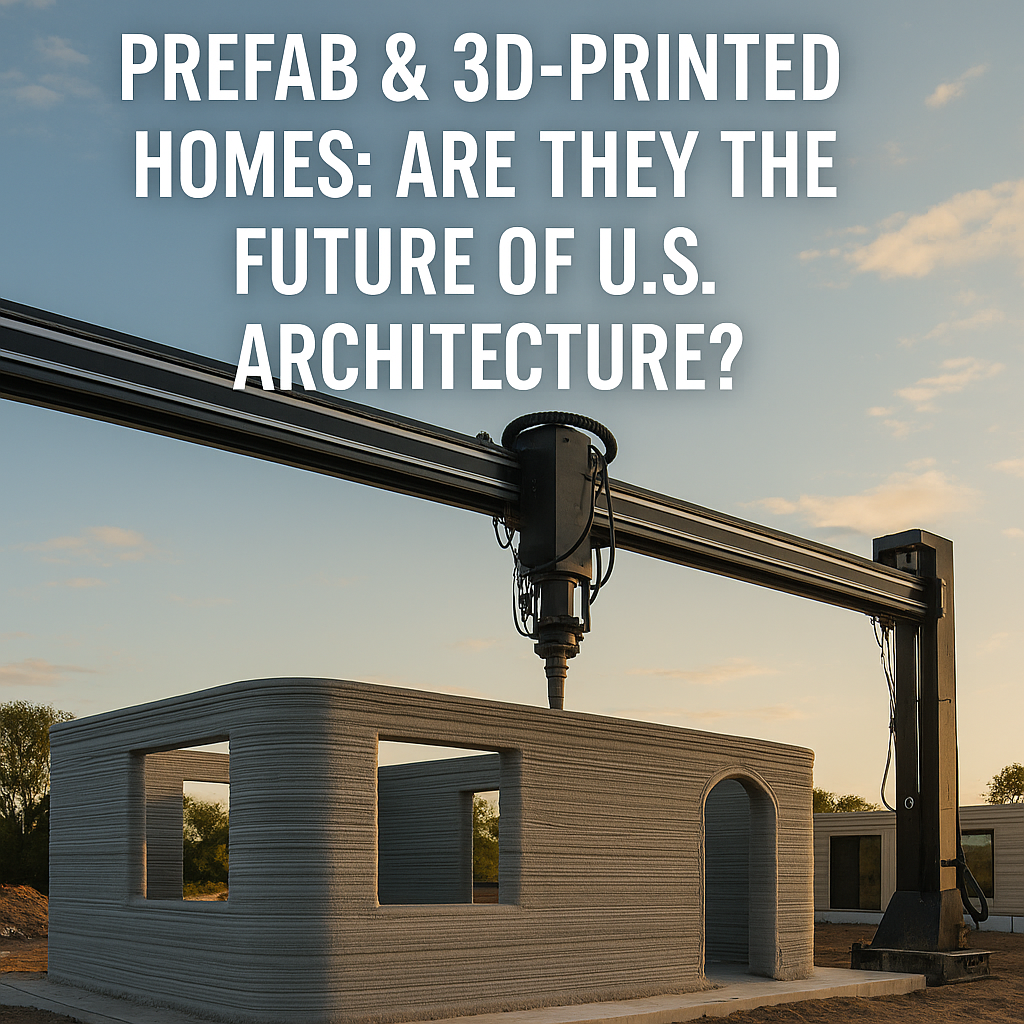
Across the United States, the way we build and think about housing is undergoing a dramatic transformation. While traditional site-built homes have long been the norm, new methods are emerging that combine technology, sustainability, and cost-efficiency. At the forefront of this architectural shift are prefabricated (prefab) homes and 3D-printed houses.
Once considered niche or experimental, these innovative building methods are gaining serious traction in both urban and rural environments. From affordable housing initiatives and disaster relief shelters to luxury modern residences and off-grid cabins, prefab and 3D-printed structures are quickly becoming more mainstream.
So, the central question arises:
Are prefab and 3D-printed homes the future of architecture in the United States?
This comprehensive guide will explore the current landscape, emerging technologies, cost dynamics, sustainability impacts, regulatory barriers, and future projections related to prefab and 3D-printed construction in the U.S.
What Are Prefab and 3D-Printed Homes?
Prefabricated (Prefab) Homes
Prefab homes are structures that are built in a controlled factory environment, then transported in parts or modules to the construction site. These homes are assembled much faster than traditional site-built structures, and they can range from modest accessory dwelling units (ADUs) to full-sized family homes and commercial buildings.
Types of prefab construction include:
- Modular Homes: Entire sections of the home—often including plumbing, insulation, and finishes—are built off-site and craned into position.
- Panelized Homes: Wall, floor, and roof panels are fabricated in the factory and assembled at the job site.
- Pre-cut or Kit Homes: Materials are precision-cut in a factory and assembled on-site, typically requiring more labor than modular units.
- Shipping Container Homes: Repurposed steel containers are used as the structural base and modified into livable spaces.
3D-Printed Homes
3D-printed homes use large-scale construction printers to deposit layers of building material—usually a concrete mix—according to a digital blueprint. The printer extrudes the material layer by layer to build up the structure’s walls and sometimes other components.
This process is largely automated and significantly faster than traditional construction, with some houses completed in less than 48 hours.
Key Technologies Behind Prefab and 3D Printing
Technologies Driving Prefab Construction
- Building Information Modeling (BIM): Digital 3D modeling allows architects, engineers, and contractors to collaborate on design and construction processes virtually before materials are fabricated.
- Computer Numerical Control (CNC) Machinery: Automated cutting of materials ensures extreme precision and waste reduction.
- Robotics and Assembly Line Manufacturing: Repetitive construction tasks are handled by machines, speeding up production and minimizing labor costs.
- Structural Insulated Panels (SIPs): Panels combining insulation and structural support enhance energy efficiency and reduce the need for additional materials.
Technologies in 3D-Printed Construction
- Gantry-Style Robotic Arms: These are the massive machines that lay down material layer-by-layer, guided by software.
- Specialized Concrete Mixes: Formulations are fast-drying and highly durable to allow for rapid, continuous construction.
- Additive Manufacturing Software: CAD (computer-aided design) tools are integrated with 3D printing hardware for precision building.
- AI and Real-Time Monitoring: Sensors and machine learning help printers adjust for environmental conditions, ensuring consistent results.
Why Are Prefab and 3D-Printed Homes Gaining Momentum?
1. Addressing the U.S. Housing Shortage
The United States faces an estimated shortfall of over 5.5 million homes. In urban centers, affordable housing is increasingly out of reach for the middle class. Prefab and 3D-printed homes offer a scalable, repeatable solution to help bridge this supply gap.
2. Solving the Labor Shortage in Construction
The construction industry is experiencing a chronic labor shortage, with more than 400,000 job openings as of 2025. Factory-built and automated construction methods dramatically reduce the need for on-site skilled labor.
3. Enhancing Sustainability and Reducing Waste
Traditional construction is responsible for nearly 38 percent of global carbon emissions. In contrast, prefab and 3D printing produce significantly less waste, require fewer raw materials, and allow for better energy efficiency.
4. Reducing Construction Timelines and Costs
With construction schedules as short as a few weeks, prefab and 3D-printed homes save on project delays, weather disruptions, and labor costs. In some cases, total project costs can be reduced by 30 to 50 percent.
Pros and Cons of Prefab and 3D-Printed Construction
Advantages
| Benefit | Explanation |
|---|---|
| Speed | Many prefab homes can be completed in 2–4 weeks; 3D-printed homes can be built in less than 72 hours. |
| Lower Costs | Reduced labor, fewer delays, and material efficiency contribute to lower total cost. |
| Sustainability | Uses less water, fewer materials, and emits less carbon during construction. |
| Quality Control | Factory conditions ensure consistent quality, regardless of outdoor weather. |
| Design Innovation | 3D printing allows for organic shapes and curved designs, previously cost-prohibitive. |
| Flexibility | Can be adapted for tiny homes, ADUs, multifamily housing, and luxury homes. |
Limitations
| Challenge | Explanation |
|---|---|
| Zoning and Code Barriers | Many local jurisdictions have not updated building codes to include 3D-printed homes. |
| Financing Difficulties | Banks and mortgage lenders are often unfamiliar with non-traditional construction methods. |
| Insurance Challenges | New construction types can confuse insurers, leading to higher premiums or exclusions. |
| Transport Limitations (Prefab) | Oversized prefab modules can be expensive and logistically complex to move. |
| Initial Setup Cost (3D Printing) | Requires a substantial investment in equipment, training, and site preparation. |
Cost Comparison: Prefab, 3D-Printed, and Traditional Homes
| Method | Avg. Cost per Sq. Ft. (2025) | Construction Time | Notes |
|---|---|---|---|
| Traditional | $150 – $250 | 6 – 12 months | Varies widely based on labor, location, and materials. |
| Prefab | $100 – $180 | 1 – 3 months | Factory-built components reduce site labor and time. |
| 3D-Printed | $80 – $120 | 1 – 6 weeks | Fastest and potentially cheapest method, limited by local code acceptance. |
Note: These are general ranges and can vary significantly by state, location, design, and site conditions.
Real-World Examples and Case Studies
ICON and Lennar’s 3D-Printed Community in Texas
One of the largest 3D-printed residential projects to date, ICON and Lennar’s 100-home community in Georgetown, Texas, features homes with 3D-printed walls, solar energy systems, and smart home features. These homes start in the $450,000 range and are built to withstand extreme weather.
Mighty Buildings in California
Mighty Buildings uses UV-cured composite panels to create modular homes in less than two weeks. Their structures are zero-net-energy ready and are being deployed in urban and suburban areas as both ADUs and primary residences.
Habitat for Humanity’s 3D Printed Home in Virginia
In 2021, Habitat for Humanity constructed its first 3D-printed home for a single mother in Williamsburg, Virginia. The total print time was less than 30 hours, and the project cost significantly less than traditional methods.
Regulatory and Zoning Challenges
Current Regulatory Barriers
- Building Codes: Many jurisdictions rely on outdated codes that don’t account for prefab or 3D-printed methods.
- Permit Delays: Getting approval for experimental or new construction techniques can take longer.
- Foundation Requirements: Printed or prefab homes still require compliant foundations, which can complicate site preparation.
- State-by-State Variability: What is legal and approvable in Texas may not be accepted in New York or California.
Progress Toward Inclusion
- The 2024 International Building Code (IBC) includes provisions for modular and additive construction.
- Municipalities like Austin, TX, Tucson, AZ, and Los Angeles, CA are piloting flexible zoning for 3D-printed homes and prefab ADUs.
- HUD is exploring updates to federal regulations to include more off-site construction options for affordable housing programs.
Environmental Impact and Sustainability Metrics
| Factor | Traditional Homes | Prefab Homes | 3D-Printed Homes |
|---|---|---|---|
| Material Waste | High | Low | Very Low |
| Energy Use During Construction | High | Moderate | Low |
| Water Use | High | Moderate | Low |
| Transportation Emissions | Variable | Moderate | Low (if printed on-site) |
| Carbon Footprint | High | 25-35% lower | Up to 60% lower |
Prefab and printed homes also serve as ideal candidates for integration with:
- Solar panels
- Rainwater harvesting systems
- Passive design for natural heating and cooling
- Green roofs or rooftop gardens
Design Innovation and Aesthetic Potential
The misconception that prefab or 3D-printed homes are sterile or unattractive is being rapidly debunked. Many of today’s units feature:
- Open-concept layouts
- Vaulted ceilings and clerestory windows
- Modernist or Scandinavian-inspired exteriors
- Organic curves made possible by 3D printing
- Custom finishes including polished concrete, timber cladding, or stone veneer
- Integrated smart home systems and energy monitoring
Architects are collaborating with technology firms to deliver beautiful, functional, and highly personalized designs.
The Future Outlook: What to Expect by 2030
- Increased Adoption: Prefab and 3D-printed homes could account for 15 to 25 percent of new builds by 2030.
- Tech-Backed Builders: Tech giants like Amazon, Google, and Tesla are investing in housing innovation.
- Urban Integration: Cities will start zoning for mid-rise modular developments and 3D-printed multifamily housing.
- Global Collaboration: International firms will enter the U.S. market, bringing new techniques from Europe and Asia.
- Sustainable Mandates: Federal and state incentives will push developers toward greener construction solutions.
Frequently Asked Questions
Q: Are prefab and 3D-printed homes legal in the U.S.?
A: Yes, they are legal in many states, but building codes and zoning laws vary. Some cities are updating their regulations to support these innovative housing types.
Q: How much does a 3D-printed home cost in the U.S.?
A: A typical 3D-printed home costs between $80 to $120 per square foot, depending on size, location, and materials used.
Q: Are prefab homes cheaper than traditional homes?
A: Yes, prefab homes can be 20–40% cheaper than traditional homes due to reduced labor, material efficiency, and shorter construction times.
Q: What are the advantages of 3D-printed homes?
A: Key benefits include faster build times, lower construction waste, improved sustainability, and cost efficiency.
Q: Can prefab or 3D-printed homes be customized?
A: Yes, many manufacturers offer customizable floor plans, finishes, and design features, including smart home integration and energy-efficient layouts.
Conclusion: A Viable and Visionary Future
Prefab and 3D-printed homes are no longer a fringe idea—they represent a powerful evolution in the built environment. They offer realistic solutions to some of America’s most pressing challenges: housing affordability, skilled labor shortages, climate change, and urban density.
As technology matures, regulations catch up, and consumer preferences evolve, prefab and 3D-printed architecture will likely shift from alternative to mainstream. Whether you are a homeowner, architect, city planner, or developer, now is the time to pay close attention to these transformative building methods.
Downloading mmliveapk now. Hope it’s as entertaining as everyone says. Fingers crossed for some good streams! Found them here: mmliveapk